What is the Earned Income Tax Credit?
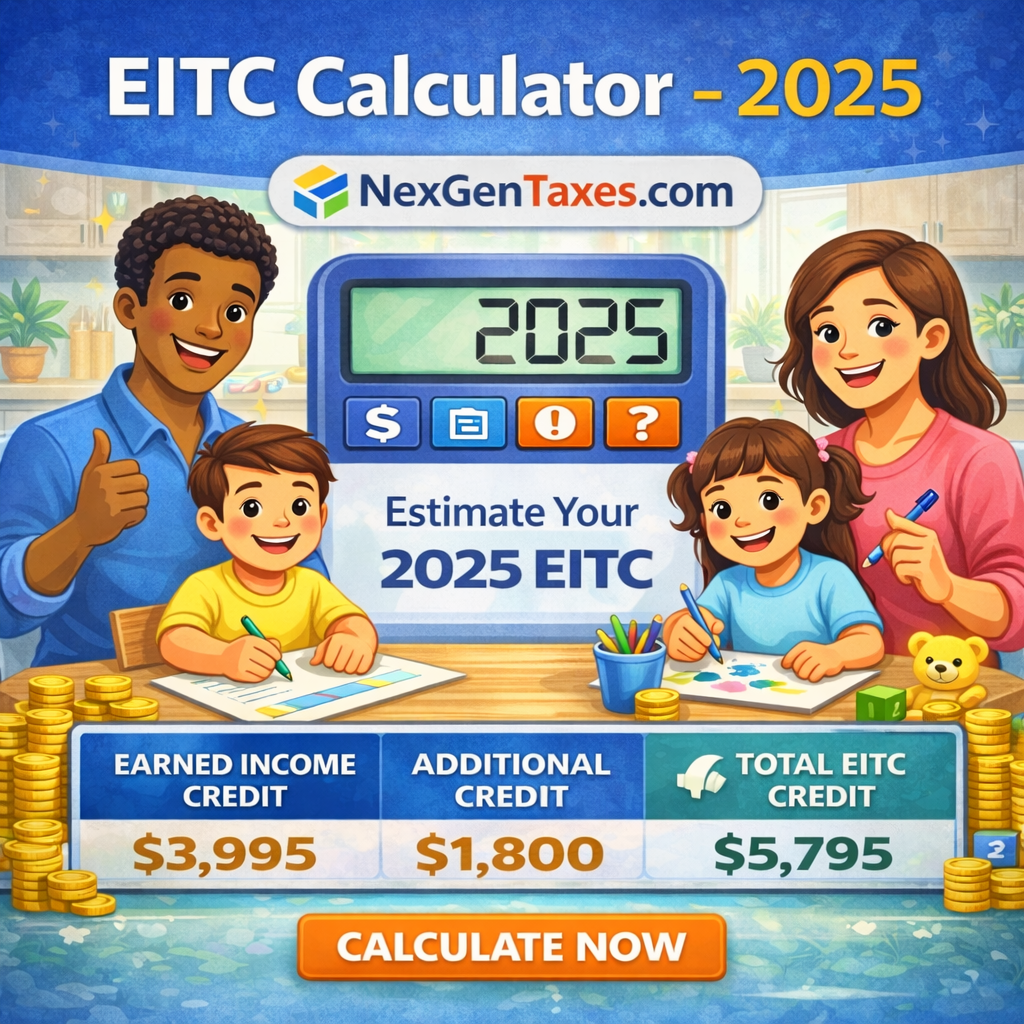
The Earned Income Tax Credit (EITC) is one of the most valuable tax benefits available to working Americans. Unlike other credits, the EITC is fully refundable - meaning you can receive the credit as a refund even if you owe no taxes.
- Maximum credit up to $7,830 for 2025 (3+ children)
- Fully refundable - get money back even with no tax liability
- Available with or without qualifying children
- Investment income must be $11,600 or less
Enter your filing status, earned income, and number of qualifying children to see if you qualify for the EITC and estimate your potential credit amount.
How to Use This EITC Calculator with Other Tools
The Earned Income Tax Credit often interacts with other family and work-related tax breaks.
After checking your EITC eligibility here, you can:
use our
Child Tax Credit Calculator
to estimate CTC and refundable ACTC,
see where your income lands with the
Tax Bracket Calculator,
and run a quick year-end check with the
Refund vs. Owe Estimator.
If you have self-employment or gig income, combine this tool with our
Self-Employment Tax Calculator
and
Quarterly Estimated Tax Calculator
to see how EITC fits into your overall tax picture.
Want to tune your paycheck so you’re not over- or under-withholding?
Use the
W-4 Withholding Calculator
to adjust your W-4 with your employer.
For official eligibility rules and examples, review the IRS guidance at
IRS Earned Income Tax Credit (EITC)
and walk through scenarios in the
IRS EITC Assistant
.
For plain-English explanations and planning ideas, see
NerdWallet’s EITC guide
and
Investopedia’s EITC overview
.
Rather have someone put this all together for you?
Our team can review your income, dependents, and filing status and make sure EITC,
Child Tax Credit, and other benefits are claimed correctly.
Talk to a NexGen Taxes pro
before you file.
Frequently Asked Questions About EITC
What is the Earned Income Tax Credit (EITC)?
+
The Earned Income Tax Credit (EITC) is a refundable federal tax credit designed to help low-to-moderate income working individuals and families. Unlike non-refundable credits that only reduce your tax liability, the EITC can result in a refund even if you owe no taxes. For 2025, the maximum EITC ranges from $632 (no children) to $7,830 (3+ children), depending on your filing status and number of qualifying children. It's one of the most valuable tax benefits available to working Americans.
Who qualifies for the EITC in 2025?
+
To qualify for EITC in 2025, you must meet these requirements: (1) Have earned income from employment or self-employment, (2) Have investment income of $11,600 or less, (3) Have a valid Social Security number for yourself, spouse (if filing jointly), and any qualifying children, (4) Be a U.S. citizen or resident alien for the entire year, (5) Not file Form 2555 (Foreign Earned Income), (6) Meet the income limits for your filing status and number of children. Important: You cannot claim EITC if you file as Married Filing Separately.
How much is the EITC worth in 2025?
+
For tax year 2025, the maximum EITC amounts are: $632 with no qualifying children, $4,213 with one qualifying child, $6,960 with two qualifying children, and $7,830 with three or more qualifying children. The actual credit you receive depends on your earned income, AGI, filing status, and number of qualifying children. The credit phases in as income increases, reaches a maximum plateau, then phases out at higher income levels.
What is a qualifying child for EITC purposes?
+
A qualifying child for EITC must meet four tests: (1) Relationship Test - must be your son, daughter, stepchild, foster child, sibling, step-sibling, half-sibling, or a descendant of any of these (grandchild, niece, nephew), (2) Age Test - must be under 19 at the end of the year, or under 24 if a full-time student, or any age if permanently and totally disabled, (3) Residency Test - must have lived with you in the United States for more than half the year, (4) Joint Return Test - cannot file a joint tax return for the year (unless only to claim a refund).
When will I receive my EITC refund?
+
By law (the PATH Act), the IRS cannot issue refunds for returns claiming EITC or the Additional Child Tax Credit before mid-February, even if you file early. If you e-file with direct deposit and there are no issues with your return, you can typically expect your refund by late February or early March. The IRS "Where's My Refund" tool at IRS.gov provides personalized refund status updates starting 24 hours after e-filing. Tips for faster refunds: file electronically, choose direct deposit, and ensure all information is accurate.
Can I claim EITC if I'm self-employed?
+
Yes, self-employment income counts as earned income for EITC purposes. This includes income from gig economy work (Uber, DoorDash, etc.), freelancing, consulting, or running your own business. Your net self-employment earnings (total income minus business expenses) are used to calculate your EITC. Keep accurate records of all income and expenses to support your claim. The IRS may request documentation to verify self-employment income.