

nexgentaxes.com

By NexGen Support Team

January 23, 2026

Roth vs Traditional IRA Calculator 2025

Compare tax-now vs tax-later retirement strategies. Find out which IRA type can maximize your retirement savings based on your current and expected future tax situation.

Which IRA is Right for You?

Choosing between a Roth IRA and a Traditional IRA is one of the most important retirement planning decisions you'll make. The right choice depends on your current tax bracket, expected retirement tax rate, and investment timeline.

  • Compare projected after-tax retirement balances for both IRA types
  • Uses 2025 federal tax brackets and contribution limits
  • Factors in your current vs expected retirement tax rates
  • Instant visual comparison with detailed breakdown

Enter your information below to see which IRA type could provide you with more after-tax retirement income.

Enter Your Information

2025 Limit: $7,000
Years until retirement: 30
Used to estimate your current tax bracket
Leave blank to auto-calculate from income
Expected tax bracket when withdrawing
Max: $7,000 (under 50) or $8,000 (50+)
Historical S&P 500 average: ~7-10%

2025 IRA Contribution Limits

Under 50: $7,000 maximum annual contribution

Age 50+: $8,000 maximum (includes $1,000 catch-up)

Your IRA Comparison

Enter your info to compare
--
Click "Compare IRAs" to see results
Roth IRA
$0
Traditional IRA
$0
Metric Roth Traditional
Annual Contribution $0 $0
Tax Paid Upfront $0 $0
Projected Balance $0 $0
Tax on Withdrawal $0 $0
Net After-Tax Value $0 $0
Total Lifetime Tax $0 $0
Need Help Choosing?
Our retirement planning experts can help you develop a personalized strategy that maximizes your tax advantages.
Get Expert Advice

How the IRA Comparison Works

1

Enter Your Details

Input your age, income, expected retirement age, and contribution amount.

2

Set Tax Rates

Enter your current tax bracket and expected retirement tax rate.

3

Compare Results

See projected balances and net after-tax values for both IRA types.

4

Make Your Decision

Use the comparison to choose the IRA that maximizes your retirement savings.

Frequently Asked Questions About Roth vs Traditional IRA

What's the difference between Roth and Traditional IRA? +

A Traditional IRA offers tax-deductible contributions now, with tax-deferred growth, but withdrawals in retirement are taxed as ordinary income. A Roth IRA uses after-tax contributions (no immediate tax break), but the account grows tax-free and qualified withdrawals in retirement are completely tax-free.

The key difference is when you pay taxes: now (Roth) or later (Traditional). Think of it as choosing between a tax break today versus tax-free income in retirement.

Which IRA is better for me - Roth or Traditional? +

The best choice depends on your current vs. expected future tax situation:

  • Choose Roth IRA if: You expect to be in a higher tax bracket in retirement, you're early in your career with lower current income, or you want tax-free withdrawals and no RMDs.
  • Choose Traditional IRA if: You expect to be in a lower tax bracket in retirement, you need the tax deduction now, or you're in your peak earning years.

Many financial advisors recommend having both types for tax diversification in retirement.

What are the IRA contribution limits for 2025? +

For 2025, the IRA contribution limits are:

  • Under age 50: $7,000 maximum annual contribution
  • Age 50 and older: $8,000 maximum (includes $1,000 catch-up contribution)

This limit applies to your combined contributions to both Traditional and Roth IRAs. You cannot contribute $7,000 to each; the total across all IRAs must not exceed the limit.

Can I contribute to both a Roth and Traditional IRA? +

Yes! You can contribute to both a Roth IRA and a Traditional IRA in the same year. However, your total combined contributions cannot exceed the annual limit ($7,000 for 2025, or $8,000 if you're 50+).

For example, you could split your contributions: $4,000 to a Traditional IRA and $3,000 to a Roth IRA. This strategy provides tax diversification, giving you both taxable and tax-free income sources in retirement.

What are the income limits for Roth IRA contributions in 2025? +

Roth IRA contributions have income limits based on your Modified Adjusted Gross Income (MAGI):

  • Single filers: Full contribution up to $150,000; phases out between $150,000-$165,000; no direct contribution above $165,000
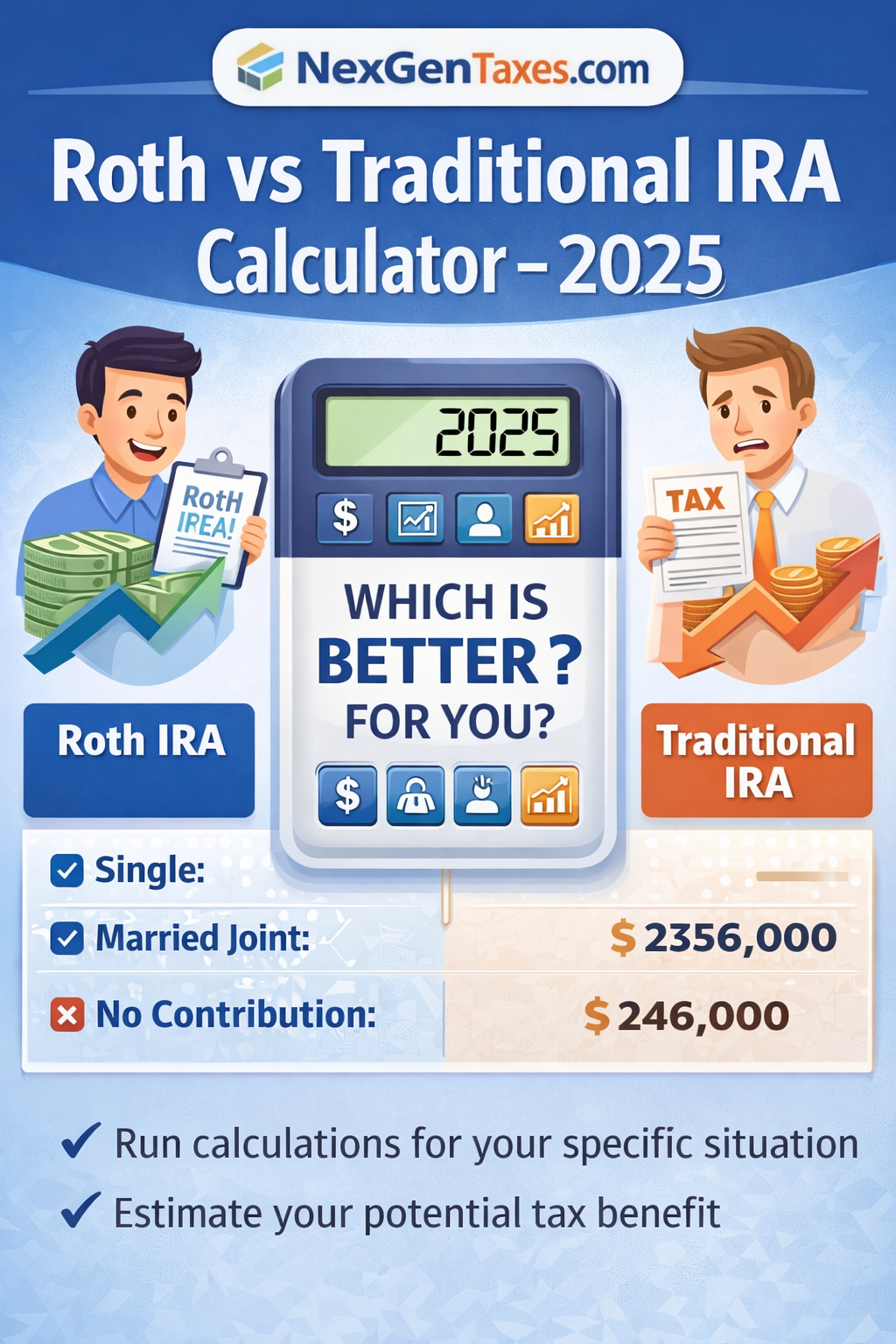
  • Married filing jointly: Full contribution up to $236,000; phases out between $236,000-$246,000; no direct contribution above $246,000

If your income exceeds these limits, consider a backdoor Roth IRA: contribute to a Traditional IRA (non-deductible) and then convert it to a Roth IRA.

When can I withdraw from my IRA without penalties? +

General withdrawal rules:

  • Age 59 1/2: You can withdraw penalty-free from both Traditional and Roth IRAs
  • Roth contributions: You can withdraw your contributions (not earnings) anytime without penalty
  • Traditional IRA RMDs: You must begin Required Minimum Distributions at age 73
  • Roth IRA: No RMDs during the owner's lifetime

Early withdrawals before 59 1/2 typically incur a 10% penalty plus taxes, with exceptions for first-time home purchase ($10,000), qualified education expenses, and certain medical situations.

Ready to Start Your IRA?

Our financial experts can help you choose the right IRA strategy and maximize your retirement savings with personalized guidance.

Get Started Today

Roth vs Traditional IRA Calculator by NexGen Taxes. Updated for tax year 2025 with current IRS contribution limits and tax brackets.